
Best 50+ Dietary Minerals MCQs – General Science Exam
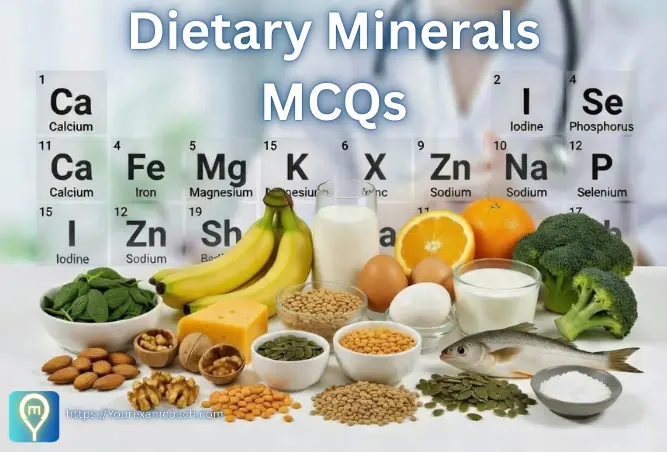
_______ are essential inorganic chemical elements that the body requires to perform vital physiological functions such as building bones, making hormones, and regulating the heartbeat.
Correct Answer: Dietary minerals
Dietary minerals are inorganic elements required for vital body functions such as bone formation, hormone production, and heartbeat regulation.
Minerals are generally classified into two groups based on daily requirement:
Correct Answer: Macrominerals and Trace Minerals
Minerals are classified as macrominerals and trace minerals depending on the amount required by the body.
Macrominerals are also known as ________.
Correct Answer: Major minerals
Macrominerals are needed in large amounts and are therefore called major minerals.
Trace minerals are also known as ________.
Correct Answer: Microminerals
Trace minerals are required in very small quantities and are also called microminerals.
Macrominerals are required in large amounts, typically ___ mg or more per day.
Correct Answer: 100
Macrominerals are minerals required by the body in amounts of 100 mg or more per day.
Calcium, phosphorus, magnesium, sodium, potassium, chloride, and sulfur are examples of _____.
Correct Answer: Macrominerals
These minerals are needed in large amounts and are classified as macrominerals.
Trace minerals are required in minute amounts, usually less than ___ mg per day.
Correct Answer: 100
Trace minerals are required by the body in quantities less than 100 mg per day.
Iron, manganese, copper, iodine, zinc, cobalt, fluoride, selenium, and molybdenum are examples of ________.
Correct Answer: Trace minerals
These minerals are needed in very small quantities and are classified as trace minerals.
______ builds bones and teeth, helps muscles contract, and blood clotting.
Correct Answer: Calcium
Calcium is essential for strong bones and teeth, muscle contraction, and proper blood clotting.
Dairy products, leafy green vegetables, and fortified cereals are good sources of ______.
Correct Answer: Calcium
Dairy products, leafy greens, and fortified cereals are rich sources of calcium.
______ is vital for hemoglobin, which carries oxygen in red blood cells.
Correct Answer: Iron
Iron is an essential mineral and a key component of hemoglobin, the protein in red blood cells that transports oxygen throughout the body.
Red meat, seafood, beans, spinach, and fortified grains are good sources of _______.
Correct Answer: Iron
These foods are rich in iron, which is necessary for oxygen transport and prevention of anemia.
______ supports over 300 enzyme reactions and aids energy production and nerve function.
Correct Answer: Magnesium
Magnesium is involved in more than 300 enzyme reactions and supports energy production, muscle movement, and nerve function.
Nuts, seeds, legumes, whole grains, and spinach are good sources of ______.
Correct Answer: Magnesium
These foods are rich sources of magnesium, which is important for enzyme activity and nerve function.
______ regulates fluid balance, nerve signals, and heart muscle function.
Correct Answer: Potassium
Potassium is a macromineral that maintains fluid balance, transmits nerve signals, and supports heart muscle contractions.
Bananas, potatoes, tomatoes, beans, and seafood are good sources of _______.
Correct Answer: Potassium
These foods are rich in potassium, which is important for heart health and muscle function.
______ supports the immune system, wound healing, and DNA synthesis.
Correct Answer: Zinc
Zinc is essential for immune response, wound healing, cell division, and DNA synthesis.
Oysters, red meat, poultry, nuts, and dairy products are good sources of ______.
Correct Answer: Zinc
These foods are excellent sources of zinc, which supports immunity, growth, and repair of tissues.
______ is essential for thyroid hormone synthesis and normal growth.
Correct Answer: Iodine
Iodine is a trace mineral required for the synthesis of thyroid hormones, which regulate growth and metabolism.
Iodized salt, seaweed, seafood, and dairy products are good sources of _______.
Correct Answer: Iodine
These foods provide iodine, which is necessary for healthy thyroid function.
Which of the following is classified as a major element?
Correct Answer: Magnesium
Magnesium is a major (macromineral), meaning it is required by the body in large amounts for functions like enzyme activity, muscle contraction, and nerve transmission.
Which trace element prevents the breakdown of fats and other body chemicals?
Correct Answer: Selenium
Selenium is a trace mineral that acts as an antioxidant, preventing oxidative breakdown of fats and other important body chemicals.
Rickets and osteoporosis are deficiency symptoms of _____.
Correct Answer: Calcium
Calcium is a major mineral essential for strong bones and teeth. Its deficiency leads to rickets in children and osteoporosis in adults.
Which mineral is responsible for red blood cell formation?
Correct Answer: Copper
Copper is a trace mineral that helps in iron metabolism and plays an important role in the formation of red blood cells.
Acid–base balance and fluid regulation between cells is carried out by ______.
Correct Answer: Chlorine
Chlorine (chloride) is a major mineral that helps maintain acid–base balance and regulates fluid movement between body cells.
Which mineral is part of the chlorophyll molecule?
Correct Answer: Magnesium
Magnesium is the central element of the chlorophyll molecule and is essential for photosynthesis in plants.
Muscle cramps, mental confusion, and irregular heart rhythm are deficiency symptoms of ______.
Correct Answer: Potassium
Potassium is a major mineral required for proper muscle contraction, nerve signaling, and heart rhythm regulation.
Fluorine deficiency causes ________.
Correct Answer: Tooth decay
Fluorine is a trace mineral that strengthens tooth enamel. Its deficiency increases the risk of tooth decay.
Which mineral is required for haemoglobin formation?
Correct Answer: Iron
Iron is an essential mineral required for the formation of haemoglobin, which carries oxygen in the blood.
Behaviour problems and spasms can occur due to deficiency of _____.
Correct Answer: Magnesium
Magnesium deficiency affects nerve transmission and muscle relaxation, leading to spasms and behavioural disturbances.