
Barrages of Pakistan – Top 40+ Mcqs for COMPETITIVE EXAMS
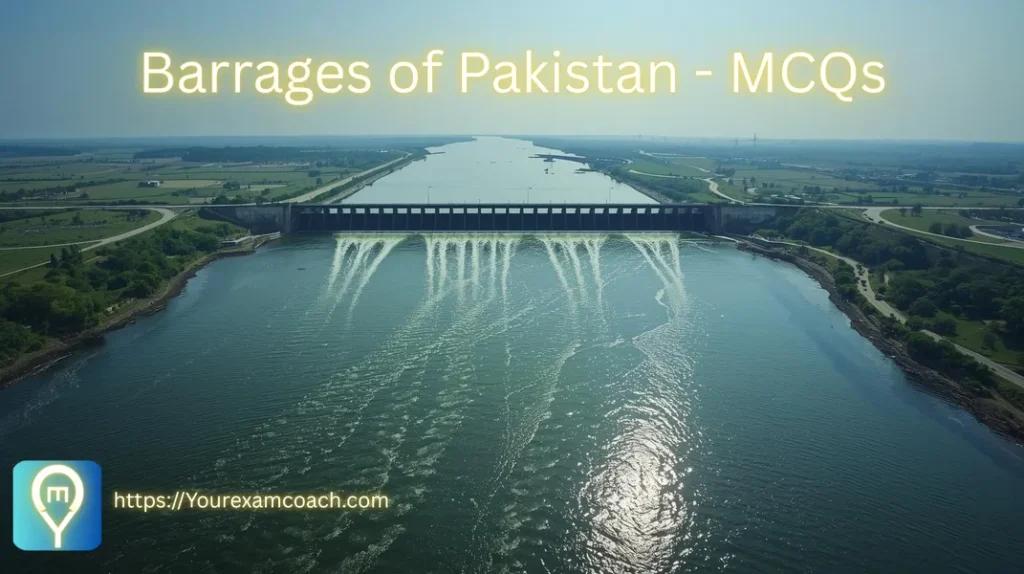
1. How many barrages are in Pakistan?
Correct Answer: C. 16
Explanation: Pakistan has a total of 16 barrages across its rivers, which are structures built to control water flow for irrigation and flood management, making option C correct.
2. How many barrages are there in Sindh?
Correct Answer: B. 3
Explanation: Sindh province has 3 major barrages—Kotri, Sukkur, and Guddu—used for irrigation and water control, proving that option B is correct.
3. The first constructed barrage in Pakistan is _____.
Correct Answer: C. Sukkur Barrage
Explanation: Sukkur Barrage was the first major barrage constructed in Pakistan in 1932 to control Indus River water for irrigation, so option C is correct.
4. The oldest Barrage of Pakistan constructed on Indus River is _____.
Correct Answer: B. Sukkur Barrage
Explanation: Sukkur Barrage, built on the Indus River in 1932, is the oldest barrage in Pakistan, confirming that option B is correct.
5. Largest Barrage of Pakistan is _____.
Correct Answer: D. Sukkur Barrage
Explanation: Sukkur Barrage is the largest barrage in Pakistan with 66 gates, spanning 1.6 km and controlling the flow of the Indus River, making option D correct.
6. The number of barrages constructed on River Indus are ___.
Correct Answer: C. 6
Explanation: There are 6 major barrages on the Indus River: Guddu, Sukkur, Kotri, Taunsa, Chashma, and Jinnah, so option C is correct.
7. Which of the following are six barrages located on Indus?
Correct Answer: A. Guddu, Sukkur, Kotri, Taunsa, Chashma, Jinnah
Explanation: The six barrages on the Indus are Guddu, Sukkur, Kotri, Taunsa, Chashma, and Jinnah, directly proving that option A is correct.
8. Which of the following was first commissioned to work?
Correct Answer: B. Sukkur Barrage
Explanation: Sukkur Barrage was commissioned first in 1932 to control the Indus River flow, so option B is correct.
9. The Sukkur Barrage is also known as ______
Correct Answer: A. Lloyd Barrage
Explanation: Sukkur Barrage was named Lloyd Barrage after Sir George Lloyd, the Governor of Bombay at that time, confirming that option A is correct.
10. Lloyd Barrage was named after _____
Correct Answer: C. Sir George Allan Lloyd
Explanation: Lloyd Barrage was named after Sir George Allan Lloyd, the then Governor of Bombay, who oversaw its construction, making option C correct.
11. Who was Sir George Allan Lloyd?
Correct Answer: C. Governor of Bombay Presidency
Explanation: Sir George Allan Lloyd was the Governor of Bombay Presidency at the time of Sukkur Barrage construction, which is why option C is correct.
12. How many canals flow from the Sukkur Barrage?
Correct Answer: C. 7
Explanation: Sukkur Barrage feeds 7 main canals, which distribute Indus River water for irrigation, making option C correct.
13. Sukkur Barrage was completed in the year ____.
Correct Answer: C. 1932
Explanation: Sukkur Barrage construction was completed in 1932, as documented in historical records of Indus irrigation projects, so option C is correct.
14. The construction of Sukkur Barrage was started in the year of ____.
Correct Answer: D. 1923
Explanation: Construction of Sukkur Barrage began in 1923, making option D correct.
15. Sukkur Barrage is built on the ___ River.
Correct Answer: A. Indus
Explanation: Sukkur Barrage is constructed on the Indus River to regulate its flow and supply water for irrigation, so option A is correct.
16. Length of Sukkur Barrage is almost ____.
Correct Answer: B. 2 km
Explanation: The Sukkur Barrage spans almost 2 km across the Indus River, confirming that option B is correct.
17. The rehabilitation of Sukkur Barrage occurred in _____.
Correct Answer: D. 2004
Explanation: The Sukkur Barrage underwent rehabilitation in 2004 to restore its structural integrity, so option D is correct.
18. Discharge capacity of Sukkur Barrage is ____.
Correct Answer: C. 1.15 million cubic feet per second
Explanation: Sukkur Barrage has a discharge capacity of 1.15 million cubic feet per second, allowing controlled flow of the Indus River, confirming option C.
19. Gates of Sukkur Barrage are ____ in numbers.
Correct Answer: D. 66
Explanation: Sukkur Barrage consists of 66 gates to manage water flow, making option D correct.
20. The longest canal among the 7 canals from Sukkur Barrage is _____.
Correct Answer: C. Nara Canal
Explanation: Nara Canal is the longest canal from Sukkur Barrage, stretching over 265 km, proving option C is correct.
21. The second largest barrage of Pakistan is:
Correct Answer: B. Guddu Barrage
Explanation: Guddu Barrage is the second largest barrage in Pakistan after Sukkur Barrage, making option B correct.
22. Guddu Barrage is built on _____ river.
Correct Answer: D. Indus
Explanation: Guddu Barrage is constructed on the Indus River to control water flow and irrigation, so option D is correct.
23. Guddu Barrage is located near _____.
Correct Answer: B. Kashmore, Sindh
Explanation: Guddu Barrage is located near the town of Kashmore in Sindh province, confirming that option B is correct.
24. Guddu Barrage was completed in the year _____.
Correct Answer: C. 1962
Explanation: Guddu Barrage was completed in 1962, confirming that option C is correct.
25. Who laid the foundation stone of Guddu Barrage on 2 February 1957?
Correct Answer: B. President Sikandar Mirza
Explanation: The foundation stone of Guddu Barrage was laid by President Iskander Mirza on 2 February 1957, making option B correct.
Barrages of Pakistan are key hydraulic structures built across rivers to regulate water flow, support irrigation, and prevent floods.
Major barrages like the Sukkur Barrage, Guddu Barrage, and Kotri Barrage are not only vital for agriculture but also frequently appear in competitive exams, making them important for aspirants preparing for General Knowledge and Pakistan Studies. Understanding these barrages, their locations, and functions can give candidates an edge, as they have appeared several times in previous exams.
Furthermore, practicing MCQs on this topic helps candidates to understand multiple issues, such as floods, climate change, water crises, dams, and energy. For official and detailed information on the Sukkur Barrage, you can visit the Sindh Irrigation Department.