
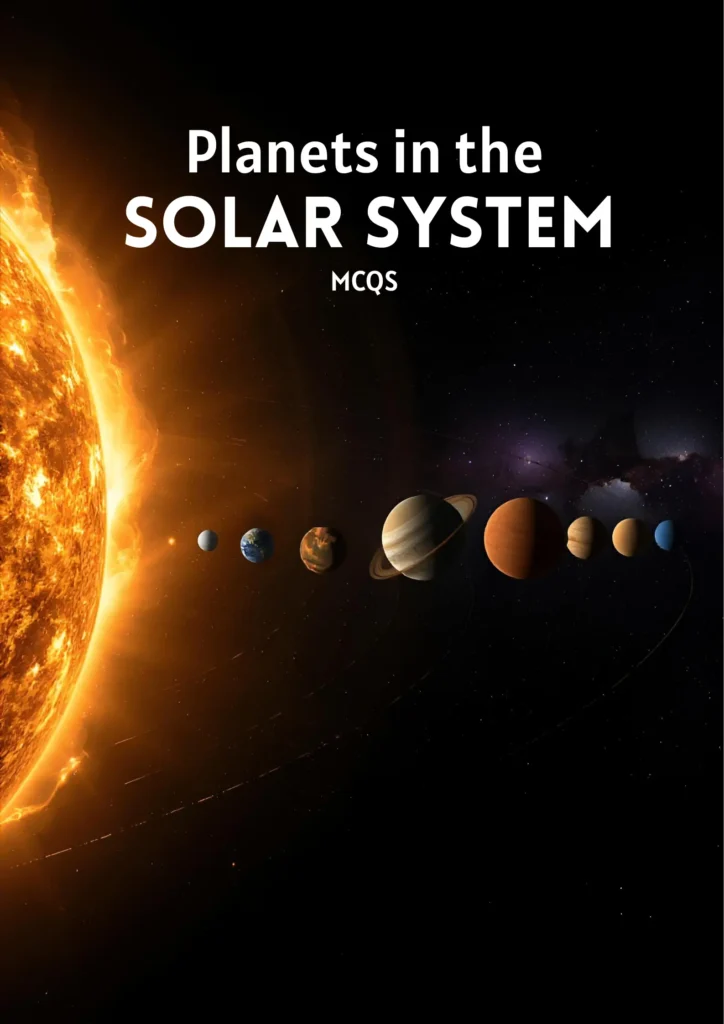
Planets in the Solar System – 40+ Most Important MCQs
The smallest planet in the Solar System is ____.
Correct Answer: Mercury
Mercury is the smallest planet with a diameter of about 4,879 km.
Among the Planets in the solar system, the brightest planet is ____.
Correct Answer: Venus
Venus shines brightly due to its highly reflective cloud cover.
The largest and heaviest planet in the Solar System is ____.
Correct Answer: Jupiter
Jupiter is the largest and most massive planet in the Solar System.
The farthest planet from the Sun is ____.
Correct Answer: Neptune
Neptune is currently the most distant planet from the Sun.
The fastest planet in the Solar System is ____.
Correct Answer: Mercury
Mercury has the fastest orbital speed, completing a revolution around the Sun in 88 days.
The coldest planet in the Solar System is ____.
Correct Answer: Neptune
Neptune has average temperatures around -214°C, making it the coldest planet.
The “Blue Planet” is ____.
Correct Answer: Neptune
Neptune is called the Blue Planet due to its methane-rich atmosphere.
Other than Earth, the Blue Planet is also ____.
Correct Answer: Neptune
Neptune is often referred to as the Giant Blue Planet.
The “Green Planet” is ____.
Correct Answer: Uranus
Uranus appears greenish-blue due to methane in its atmosphere.
The “Ring Planet” is ____.
Correct Answer: Saturn
Saturn is famous for its prominent rings made of ice and rock.
The “Red Planet” is ____.
Correct Answer: Mars
Mars is called the Red Planet due to its reddish iron-rich soil.
The hottest planet in the Solar System is ____.
Correct Answer: Venus
Venus has the highest surface temperature (~465°C) due to its dense greenhouse gas atmosphere.
Planet with the shortest year is ____.
Correct Answer: Mercury
Mercury completes its orbit around the Sun in just 88 Earth days, making its year the shortest.
Which planet can be seen with the naked eye in the morning or in the evening?
Correct Answer: Venus
Venus, known as the “Morning Star” or “Evening Star,” is bright enough to be seen without a telescope.
Mercury has _____ moons.
Correct Answer: 0
Mercury has no moons or natural satellites.
How many terrestrial planets are there in the Solar System?
Correct Answer: 4
The four terrestrial planets are Mercury, Venus, Earth, and Mars, made of rock and metal.
How many Jovian (gas giant) planets are there in the Solar System?
Correct Answer: 4
The four Jovian planets are Jupiter, Saturn, Uranus, and Neptune.
The nearest planet to the Sun is _____.
Correct Answer: Mercury
Mercury is the closest planet to the Sun at an average distance of about 57.9 million km.
The surface of Mercury is covered with holes called ____.
Correct Answer: Craters
Mercury is heavily cratered due to collisions with asteroids and meteoroids.
Venus has ____ Moons.
Correct Answer: 0
Venus does not have any natural satellites.