
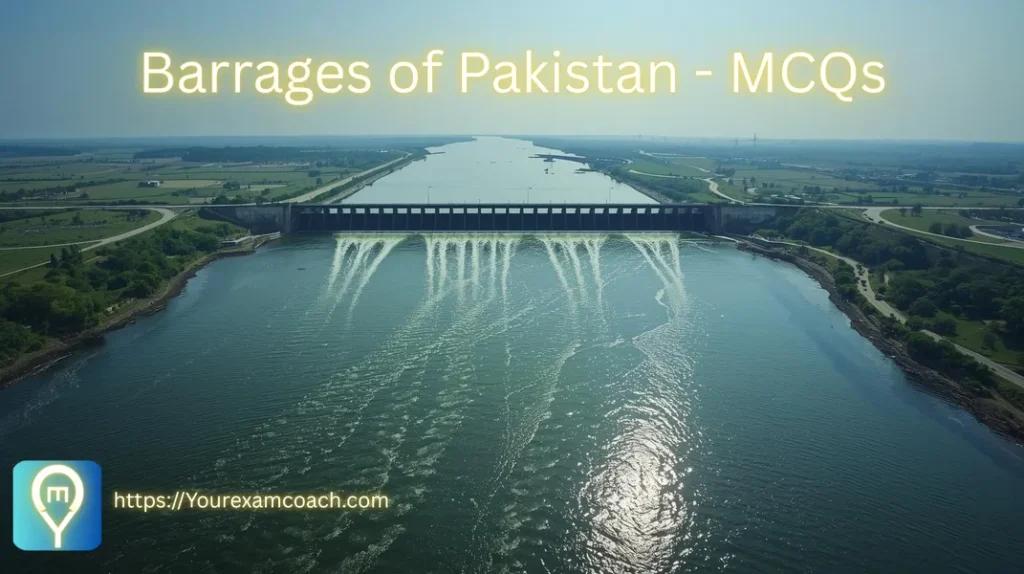
26. Guddu Barrage was inaugurated by ______.
Correct Answer: A. Ayub Khan
Explanation: Guddu Barrage was inaugurated by President Ayub Khan, confirming option A as correct.
27. Guddu Barrage has the discharge capacity of:
Correct Answer: D. 1.2 million cubic feet per second
Explanation: Guddu Barrage has a discharge capacity of 1.2 million cubic feet per second, confirming option D.
28. Guddu Barrage consists of ____ gates.
Correct Answer: C. 64
Explanation: Guddu Barrage has 64 gates to control water flow, making option C correct.
29. Guddu Barrage is named after Guddu. What is Guddu?
Correct Answer: B. A small town and railway station in Kashmore district
Explanation: Guddu Barrage is named after the small town and railway station “Guddu” in Kashmore district, confirming option B.
30. Kotri Barrage is also known as:
Correct Answer: B. Ghulam Muhammad Barrage
Explanation: Kotri Barrage is also known as Ghulam Muhammad Barrage, named after the then President of Pakistan, making option B correct.
31. Kotri Barrage was completed in the year of _____.
Correct Answer: A. 1955
Explanation: Kotri Barrage was completed in 1955, confirming option A is correct.
32. Kotri Barrage was inaugurated by _____.
Correct Answer: B. Ghulam Muhammad
Explanation: Kotri Barrage was inaugurated by President Ghulam Muhammad, so option B is correct.
33. Kotri Barrage has a discharge capacity of _____.
Correct Answer: C. 875,000 cubic feet per second
Explanation: Kotri Barrage has a discharge capacity of 875,000 cubic feet per second, making option C correct.
34. Kotri Barrage has ____ gates.
Correct Answer: C. 44
Explanation: Kotri Barrage consists of 44 gates to regulate water flow, confirming option C.
35. How wide is one gate of Kotri Barrage?
Correct Answer: C. 18 meters
Explanation: Each gate of Kotri Barrage is 18 meters wide, confirming option C is correct.
36. The oldest headworks in Pakistan is:
Correct Answer: B. Khanki Headworks
Explanation: Khanki Headworks is the oldest headworks in Pakistan, constructed in the 19th century, so option B is correct.
37. Khanki Headworks is situated on ______ river.
Correct Answer: D. Chenab
Explanation: Khanki Headworks is situated on the Chenab River, making option D correct.
38. Khanki Headworks is located in ______.
Correct Answer: B. Wazirabad, Gujrat, Punjab
Explanation: Khanki Headworks is located in Wazirabad, Gujrat district of Punjab, so option B is correct.
39. The construction of Khanki Headworks started in the year of _____.
Correct Answer: A. 1882
Explanation: Construction of Khanki Headworks started in 1882, making option A correct.
40. The construction of Khanki Headworks was completed in _____.
Correct Answer: D. 1889
Explanation: Khanki Headworks was completed in 1889, confirming option D.
41. Chashma Barrage was built in 1971 on _____ river.
Correct Answer: C. Indus
Explanation: Chashma Barrage was built on the Indus River in Mianwali district in 1971, making option C correct.
42. Main purpose of Chashma Barrage is _____.
Correct Answer: C. Irrigation of land
Explanation: The primary purpose of Chashma Barrage is to provide irrigation to agricultural land, so option C is correct.
Barrages of Pakistan are key hydraulic structures built across rivers to regulate water flow, support irrigation, and prevent floods.
Major barrages like the Sukkur Barrage, Guddu Barrage, and Kotri Barrage are not only vital for agriculture but also frequently appear in competitive exams, making them important for aspirants preparing for General Knowledge and Pakistan Studies. Understanding these barrages, their locations, and functions can give candidates an edge, as they have appeared several times in previous exams.
Furthermore, practicing MCQs on this topic helps candidates to understand multiple issues, such as floods, climate change, water crises, dams, and energy. For official and detailed information on the Sukkur Barrage, you can visit the Sindh Irrigation Department.