
Top 90+ free MCQs On “Hajj in Islam” – 🕋 – Islamic Studies
Tawhid is the first pillar of Islam, while Hajj is the fifth. It is obligatory for Muslims to perform Hajj at least once in their lifetime, provided they meet the required conditions. Hajj holds immense significance as it is a divine obligation from Allah. It serves as a complete physical, mental, and spiritual journey, offering profound healing to the souls of the pilgrims (hujjaj). In the field of Islamic Studies, multiple-choice questions (MCQs) related to Hajj frequently appear in competitive exams like CSS, PMS, CCE, etc. Therefore, our team has compiled a summary of past exam questions, along with a list of potential questions that may feature in future tests, as outlined below.
![Qurbani [Hajj in Islam],](https://yourexamcoach.com/wp-content/uploads/2025/06/22.37.png "Hajj in Islam 1")
1. In Arabic, the word “Hajj” means ______.
Correct Answer: B. Pilgrimage
Explanation: In Arabic, “Hajj” means pilgrimage — the sacred journey Muslims undertake to Makkah as one of the Five Pillars of Islam.
2. The literal meaning of Hajj is to intend to go somewhere for _________.
Correct Answer: C. The sake of Visiting
Explanation: The literal meaning of Hajj in Islam is “to intend to visit” — specifically to visit the Sacred House of Allah in Makkah.
3. Hajj was made obligatory in the _____.
Correct Answer: C. 9th A.H
Explanation: Hajj in Islam was made obligatory in the 9th year after Hijrah, during the lifetime of Prophet Muhammad (PBUH).
4. The first Hajj was performed by ______.
Correct Answer: C. Hazrat Adam (A.S) & Hazrat Hawa
Explanation: The first Hajj was performed by Hazrat Adam (A.S) and Hazrat Hawa, as commanded by Allah.
5. The ritual of Hajj in Islam is performed in the Islamic month of ________.
Correct Answer: D. Zilhajj
Explanation: Hajj is performed during the month of Zilhajj, the 12th month of the Islamic calendar, from 8th Zilhajj to 12th Zilhajj in Makkah.
6. “Maqbool Hajj” means a Hajj which is ______.
Correct Answer: A. Accepted
Explanation: “Maqbool Hajj” refers to a Hajj that is accepted by Allah due to sincerity and righteousness. The word Maqbool is derived from the word “qubool” which means to accept.
7. “Mabroor Hajj” means a Hajj that is observed _____.
Correct Answer: C. Correctly
Explanation: “Mabroor Hajj” means a Hajj in Islam that is performed properly, and followed by righteous deeds.
8. The typical way of wearing the dress of Hajj is called ______.
Correct Answer: B. Iztibah
Explanation: “Iztibah” is the manner in which male pilgrims wear the Ihram, with one shoulder uncovered.
9. The ritual of Hajj in Islam is performed _____ days.
Correct Answer: A. Five
Explanation: The rituals of Hajj in Islam are performed over five days, from the 8th to the 12th of Zilhajj.
10. The 9th of Zilhajj is also known as _____.
Correct Answer: B. Day of Arafat
Explanation: During Hajj in Islam, the 9th of Zilhajj is known as the Day of Arafat, when pilgrims stand in prayer at the plain of Arafat.
11. Wuquf-e-Arafat refers to the stay in the plain of _____.
Correct Answer: C. Arafat
Explanation: Wuquf-e-Arafat means standing in the plain of Arafat on the 9th of Zilhajj, which is an essential part of Hajj.
12. Hajj in Islam is not considered complete without visiting ________.
Correct Answer: B. Arafat
Explanation: Standing at Arafat (Wuquf-e-Arafat) is the most essential rite of Hajj. Without it, Hajj is invalid.
13. Most important step of Hajj in Islam after Wuquf is ______.
Correct Answer: A. Tawaf
Explanation: During Hajj in Islam, after standing at Arafat, the next most important act is Tawaf — circling the Kaaba seven times.
14. Tawaf involves walking around the Kaaba ___ times.
Correct Answer: C. Seven
Explanation: Tawaf consists of making seven counterclockwise circuits around the Kaaba, starting from Hajr-e-Aswad.
15. The wall of the Kaaba between its door and Hajr-e-Aswad is called:
Correct Answer: B. Al-Multazam
Explanation: The wall between the Kaaba’s door and the Black Stone (Hajr-e-Aswad) is called Al-Multazam.
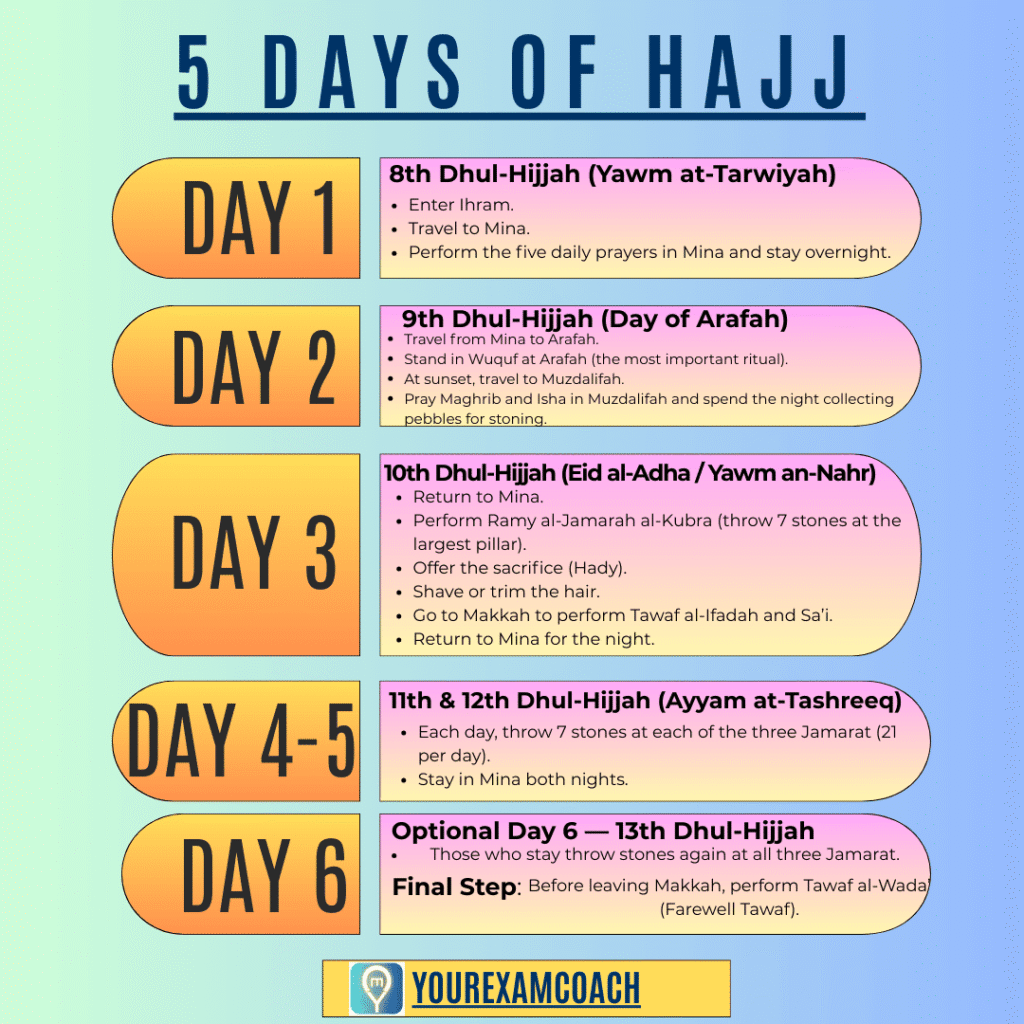
16. The three days after Yawm ul Nahr are known as ________.
Correct Answer: B. Ayyam al-Tashreeq
Explanation: The three days following the Day of Sacrifice (Yawm-ul-Nahr) are called Ayyam al-Tashreeq.
17. The first Farz of Hajj in Islam is _________.
Correct Answer: A. Ihram
Explanation: The first obligatory act of Hajj in Islam is wearing Ihram, the sacred state and clothing for pilgrims.
18. The second Farz of Hajj in Islam is ________.
Correct Answer: B. Wuquf-e-Arafat
Explanation: Wuquf-e-Arafat, standing at Arafat, is the second Farz of Hajj in Islam and an essential act.
19. The third Farz of Hajj in Islam is ______.
Correct Answer: C. Tawaf-e-Ziyarah
Explanation: Tawaf-e-Ziyarah is the third Farz of Hajj, performed after the Day of Sacrifice.
20. There are ___ Sunnahs of Hajj in Islam.
Correct Answer: D. 8
Explanation: Hajj in Islam has 8 Sunnahs, which are recommended practices to be observed during the pilgrimage.
21. ______ is the sacred state that a Muslim must enter before performing Hajj or Umrah.
Correct Answer: C. Ihram
Explanation: Ihram is the sacred state a Muslim enters, wearing special clothing and observing restrictions, before performing Hajj or Umrah.
22. What does Hajj mean in Islam?
Correct Answer: C. To intend
Explanation: Hajj literally means “to intend” — to set out with the intention to perform the pilgrimage for Allah.
23. Hajj in Islam was made compulsory in the year of _____ A.H.
Correct Answer: C. 9 A.H.
Explanation: Hajj in Islam was made obligatory in 9 A.H., the year during Prophet Muhammad’s (PBUH) lifetime when pilgrimage became compulsory for Muslims.
24. _____ led the first Hajj in Islam after it was made obligatory for Muslims.
Correct Answer: B. Abu Bakr (RA)
Explanation: Abu Bakr (RA) led the first Hajj in Islam after it became obligatory for Muslims.
25. When did Prophet Muhammad (PBUH) perform his first and only Hajj?
Correct Answer: C. 10 A.H.
Explanation: Prophet Muhammad (PBUH) performed his only Hajj in 10 A.H., known as Hajj al-Wida (Farewell Pilgrimage).
26. The first Hajj in Islam was offered in the year of ___.
Correct Answer: C. 9 A.H.
Explanation: The first Hajj offered in Islam took place in 9 A.H., following the year it was made obligatory.
27. Hajj was commanded in Surah _____.
Correct Answer: B. Surah Al-Baqarah
Explanation: Hajj is mentioned in Surah Al-Baqarah, verses commanding the pilgrimage to the Kaaba for all able Muslims.
28. How many Hajj did the Holy Prophet Muhammad (PBUH) perform?
Correct Answer: B. One
Explanation: The Holy Prophet Muhammad (PBUH) performed only one Hajj, known as the Farewell Hajj.
29. How many types of Hajj in Islam are there?
Correct Answer: C. 3
Explanation: There are three types of Hajj in Islam: Hajj Ifrad, Hajj Qiran, and Hajj Tamattu.
30. One Tawaf of the Kaaba is known as _____.
Correct Answer: B. Shawt
Explanation: One complete circumambulation of the Kaaba is called Shawt.
Jazak Allah