
![Qurbani [Hajj in Islam],](https://yourexamcoach.com/wp-content/uploads/2025/06/22.37.png "Hajj in Islam 1")
31. The starting point of Tawaf is _____.
Correct Answer: C. Hajar al-Aswad (green Light)
Explanation: Tawaf begins at Hajar al-Aswad, the Black Stone, which pilgrims kiss or point towards as they start.
32. How many Jamarat are there?
Correct Answer: C. 3
Explanation: There are three Jamarat (small, medium, and large) where pilgrims throw pebbles during Hajj.
33. The mosque located in Mina is known as ____.
Correct Answer: A. Khief
Explanation: The mosque in Mina is called Masjid al-Khief, where pilgrims perform prayers during Hajj.
34. Where do the Hujjaj assume the state of Ihram?
Correct Answer: C. Meeqat
Explanation: Pilgrims enter the sacred state of Ihram at Meeqat, designated locations around Makkah.
35. What is recited during Hajj?
Correct Answer: C. Talbiyah
Explanation: During Hajj, pilgrims continuously recite the Talbiyah to show readiness and devotion.
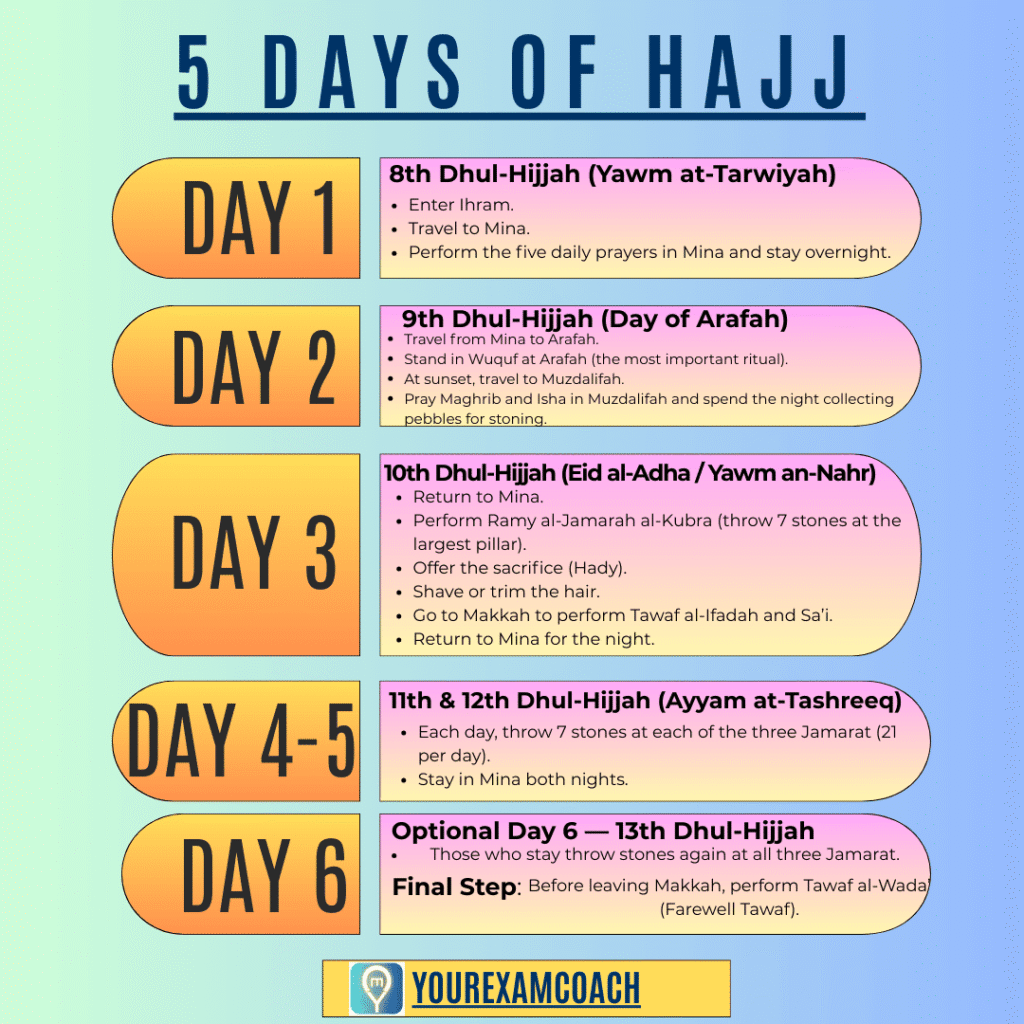
36. During Hajj in Islam, the ritual of offering sacrifice is performed at ____:
Correct Answer: B. Mina
Explanation: Sacrifice (Qurbani) is performed at Mina during the days of Hajj following the day of Arafat.
37. The Jamrat throwing is performed:
Correct Answer: C. 10th, 11th, and 12th Zul-Hajj
Explanation: Jamrat throwing is done on the 10th, 11th, and 12th of Zul-Hajj at Mina.
38. During Hajj in Islam, Maghrib and Isha prayers are offered together at ___:
Correct Answer: C. Muzdalifah
Explanation: Maghrib and Isha prayers are combined and offered at Muzdalifah after sunset on the 9th of Zul-Hajj.
39. What is Youm e Arafat called?
Correct Answer: C. Hajj Day
Explanation: Youm e Arafat is Hajj Day, the 9th of Zul-Hajj, when pilgrims stand on the plain of Arafat in supplication.
40. During Hajj in Islam, where do pilgrims go after Arafat?
Correct Answer: B. Muzdalifah
Explanation: After standing at Arafat, pilgrims move to Muzdalifah to spend the night and collect pebbles for Rami.
41. Who is believed to have built the first structure of the Kaaba?
Correct Answer: A. Adam
Explanation: According to Islamic tradition, Adam built the first structure of the Kaaba on Earth.
42. What is the Day of Sacrifice called during Hajj?
Correct Answer: A. Youm-e-Nahar
Explanation: The Day of Sacrifice is Youm-e-Nahar, observed on the 10th of Zul-Hajj.
43. When is Youm e Arafat observed?
Correct Answer: B. 9th Zul-Hajj
Explanation: Youm e Arafat is observed on the 9th of Zul-Hajj, the day pilgrims stand at the plain of Arafat in supplication.
44. How many official Khutbahs (sermons) are delivered during Hajj in Islam?
Correct Answer: C. One
Explanation: Only one official Khutbah is delivered during Hajj, typically on the Day of Arafat.
45. Which verse of Surah Al Baqarah contains the command for Hajj?
Correct Answer: C. 2:196
Explanation: Verse 2:196 of Surah Al-Baqarah contains the command to perform Hajj and outlines its obligations.
46. How many camels did the Holy Prophet sacrifice during Hajj?
Correct Answer: A. 63
Explanation: The Holy Prophet Muhammad (PBUH) sacrificed 63 camels during his Hajj as per Sunnah.
47. Who is believed to have performed the first-ever Hajj?
Correct Answer: C. Adam & Hawa
Explanation: According to Islamic tradition, Adam and Hawa performed the first-ever Hajj on Earth.
48. The act of running between Safa and Marwa seven times is called _____:
Correct Answer: A. Sayee
Explanation: The ritual of running or walking seven times between Safa and Marwa is called Sayee.
49. What is the most important step of Hajj after assuming Ihram?
Correct Answer: A. Wuquf
Explanation: Wuquf at Arafat is the most important step of Hajj after assuming Ihram.
50. The Rukn-e-Azam of Hajj in Islam is ______:
Correct Answer: B. Waqoof e Arfah
Explanation: Waqoof-e-Arafah is considered the Rukn-e-Azam (most important pillar) of Hajj.
51. The majority of Hajj obligations are performed after ____:
Correct Answer: C. After Rami on the 10th Zul-Hajj
Explanation: Most Hajj obligations are performed after Rami on the 10th Zul-Hajj following Waqoof-e-Arafah.
52. What are the three upright stones called?
Correct Answer: A. Jamarat
Explanation: The three upright stones in Mina, which pilgrims throw pebbles at, are called Jamarat.
53. After Waquf, what is the most important step of Hajj?
Correct Answer: C. Tawaf
Explanation: After Waqoof-e-Arafah, Tawaf is the most important step of Hajj.
54. How many Farz (obligations) are there in Hajj in Islam?
Correct Answer: C. 3
Explanation: There are 3 Farz (obligatory) acts in Hajj.
55. Umrah cannot be performed on:
Correct Answer: B. 9th to 11th Zul-Hajj
Explanation: Umrah cannot be performed from the 9th to 11th Zul-Hajj as Hajj rituals are observed during this period.
56. Who said that Hajj is the greatest of all worships?
Correct Answer: A. Imam Malik
Explanation: Imam Malik stated that Hajj is the greatest of all worships.
57. How many undesirable acts of Ihram are there?
Correct Answer: A. Six
Explanation: There are six undesirable acts (Makruh) of Ihram that should be avoided.
58. How many prohibitions and restrictions are there in Ihram?
Correct Answer: C. 8
Explanation: There are eight prohibitions and restrictions that a pilgrim must observe during Ihram.
59. What is the first and foremost Farz of Hajj and Umrah?
Correct Answer: A. Ihram
Explanation: Assuming Ihram is the first and foremost Farz of Hajj and Umrah.
60. The first corner of Khana e Kaaba is known as ____.
Correct Answer: A. Black stone Corner
Explanation: The first corner of the Kaaba is known as the Black Stone Corner (Rukn al-Aswad).
46. How many camels did the Holy Prophet sacrifice during Hajj?
Correct Answer: A. 63
Explanation: The Holy Prophet Muhammad (PBUH) sacrificed 63 camels during his Hajj as per Sunnah.
47. Who is believed to have performed the first-ever Hajj?
Correct Answer: C. Adam & Hawa
Explanation: According to Islamic tradition, Adam and Hawa performed the first-ever Hajj on Earth.
48. The act of running between Safa and Marwa seven times is called _____:
Correct Answer: A. Sayee
Explanation: The ritual of running or walking seven times between Safa and Marwa is called Sayee.
49. What is the most important step of Hajj after assuming Ihram?
Correct Answer: A. Wuquf
Explanation: Wuquf at Arafat is the most important step of Hajj after assuming Ihram.
50. The Rukn-e-Azam of Hajj in Islam is ______:
Correct Answer: B. Waqoof e Arfah
Explanation: Waqoof-e-Arafah is considered the Rukn-e-Azam (most important pillar) of Hajj.
51. The majority of Hajj obligations are performed after ____:
Correct Answer: C. After Rami on the 10th Zul-Hajj
Explanation: Most Hajj obligations are performed after Rami on the 10th Zul-Hajj following Waqoof-e-Arafah.
52. What are the three upright stones called?
Correct Answer: A. Jamarat
Explanation: The three upright stones in Mina, which pilgrims throw pebbles at, are called Jamarat.
53. After Waquf, what is the most important step of Hajj?
Correct Answer: C. Tawaf
Explanation: After Waqoof-e-Arafah, Tawaf is the most important step of Hajj.
54. How many Farz (obligations) are there in Hajj in Islam?
Correct Answer: C. 3
Explanation: There are 3 Farz (obligatory) acts in Hajj.
55. Umrah cannot be performed on:
Correct Answer: B. 9th to 11th Zul-Hajj
Explanation: Umrah cannot be performed from the 9th to 11th Zul-Hajj as Hajj rituals are observed during this period.
56. Who said that Hajj is the greatest of all worships?
Correct Answer: A. Imam Malik
Explanation: Imam Malik stated that Hajj is the greatest of all worships.
57. How many undesirable acts of Ihram are there?
Correct Answer: A. Six
Explanation: There are six undesirable acts (Makruh) of Ihram that should be avoided.
58. How many prohibitions and restrictions are there in Ihram?
Correct Answer: C. 8
Explanation: There are eight prohibitions and restrictions that a pilgrim must observe during Ihram.
59. What is the first and foremost Farz of Hajj and Umrah?
Correct Answer: A. Ihram
Explanation: Assuming Ihram is the first and foremost Farz of Hajj and Umrah.
60. The first corner of Khana e Kaaba is known as ____.
Correct Answer: A. Black stone Corner
Explanation: The first corner of the Kaaba is known as the Black Stone Corner (Rukn al-Aswad).