
![Qurbani [Hajj in Islam],](https://yourexamcoach.com/wp-content/uploads/2025/06/22.37.png "Hajj in Islam 1")
61. The area where the Tawaf takes place is known as _____.
Correct Answer: A. Mataf
Explanation: The area around the Kaaba where pilgrims perform Tawaf is called Mataf.
62. Who fixed the boundaries of Haram?
Correct Answer: B. Ibrahim
Explanation: Prophet Ibrahim (AS) is believed to have fixed the boundaries of the Haram.
63. What is the fourth corner of the Kaaba?
Correct Answer: D. Yemeni Corner
Explanation: The fourth corner of the Kaaba is the Yemeni Corner (Rukn al-Yamani).
64. Where do pilgrims have to put on Ihram?
Correct Answer: A. Mowaqeet
Explanation: Pilgrims put on Ihram at designated points called Mawaqeet before entering the state of Ihram.
65. Who built the Kaaba first in the universe?
Correct Answer: B. Angels
Explanation: According to Islamic tradition, angels built the Kaaba first in the universe.
66. When did the Kaaba disappear ______?
Correct Answer: A. During the flood of Noah
Explanation: The Kaaba is believed to have disappeared during the flood of Prophet Noah (AS).
67. First gate of Masjid e Nabawi is known as _____.
Correct Answer: A. Bab-e-Salam
Explanation: The first gate of Masjid e Nabawi is called Bab-e-Salam.
68. The meaning of Bab e Salam means _______.
Correct Answer: B. The Door of Peace
Explanation: Bab-e-Salam means “The Door of Peace.”
69. What does Hajr-e-Aswad mean?
Correct Answer: A. Black Stone
Explanation: Hajr-e-Aswad translates to “Black Stone,” which is set in the eastern corner of the Kaaba.
70. What was the original color of Hajr-e-Aswad?
Correct Answer: A. White
Explanation: The Black Stone (Hajr-e-Aswad) was originally white and turned black due to absorbing the sins of those who touched it.
71. What is the small piece of land between Rukn-e-Islam and Rukn-e-Yamani called?
Correct Answer: A. Hateem
Explanation: The small area between Rukn-e-Islam and Rukn-e-Yamani is called Hateem, which is considered part of the Kaaba.
72. Where is prayer offered like offering prayer inside the Kaaba?
Correct Answer: A. Hateem
Explanation: Prayer offered within the area of Hateem is considered equivalent to offering prayer inside the Kaaba.
73. How many well known types of Tawaf are there?
Correct Answer: A. 5
Explanation: There are five well-known types of Tawaf: Tawaf al-Qudum, Tawaf al-Ifadah, Tawaf al-Wada, Tawaf al-Umrah, and Tawaf al-Nafl.
74. Where do Hajjis go after completing the seven rounds of Tawaf?
Correct Answer: B. Masjid al-Haram
Explanation: After Tawaf, Hajjis often go to pray in Masjid al-Haram and then proceed to other rituals such as Sayee.
75. What does Al-Multazim mean?
Correct Answer: A. Place of holding
Explanation: Al-Multazim is the area of the Kaaba wall between the Black Stone and the door, where pilgrims hold on and pray.
76. What is the portion of the wall of Kaaba between its door and Hajr-e-Aswad called?
Correct Answer: A. Al-Multazim
Explanation: The portion of the Kaaba wall between its door and Hajr-e-Aswad is known as Al-Multazim.
77. Sayee commence from ____.
Correct Answer: A. Safa
Explanation: Sayee begins at Safa, and pilgrims walk back and forth seven times between Safa and Marwa.
78. Where do Hajjis go after performing Sayee?
Correct Answer: B. Mina
Explanation: After Sayee, pilgrims go to Mina for the next steps of Hajj rituals.
79. What Hajjis do in Mina?
Correct Answer: A. To stay overnight
Explanation: Hajjis stay overnight in Mina as part of the ritual, particularly on the 10th of Zul-Hajj.
80. What type of land is Muzdalifah?
Correct Answer: A. Plain
Explanation: Muzdalifah is a flat plain where pilgrims stay overnight during Hajj.
81. Muzdalifah is located between _____.
Correct Answer: A. Mina and Arafat
Explanation: Muzdalifah is located between Mina and Arafat along the Hajj route.
82. How far is Muzdalifah from Makkah?
Correct Answer: C. 6 miles
Explanation: Muzdalifah is approximately 6 miles from Makkah.
83. How far is Muzdalifah from Mina?
Correct Answer: B. 3 miles
Explanation: Muzdalifah is about 3 miles from Mina.
84. What is referred to as the “Sacred Monument” in the Quran during Hajj?
Correct Answer: C. Al-Mash’ar al-Haram (Muzdalifah)
Explanation: The Quran refers to Muzdalifah as Al-Mash’ar al-Haram, the sacred place for Hajj pilgrims.
85. What prayers are offered together at Muzdalifah?
Correct Answer: A. Maghrib & Isha
Explanation: At Muzdalifah, Maghrib and Isha prayers are combined and performed together.
86. Where are pebbles collected during Hajj in Islam?
Correct Answer: A. Muzdalifah
Explanation: Pebbles for Rami (stoning Jamarat) are collected at Muzdalifah.
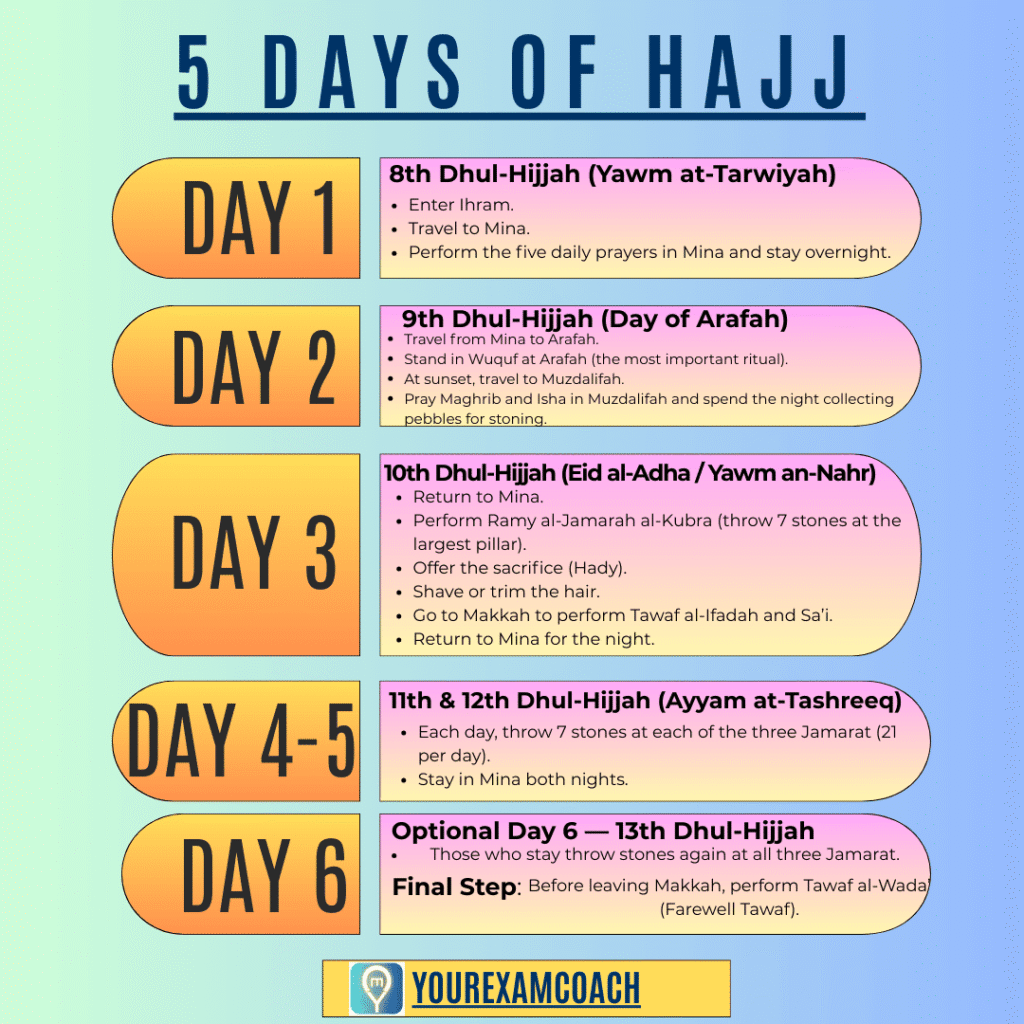
87. Jamarat nearest to Makkah is ______.
Correct Answer: A. Jamarat al-Aqaba
Explanation: Jamarat al-Aqaba is the closest to Makkah.
88. The smallest Jamarat is _______.
Correct Answer: A. Jamarat al-Sughra
Explanation: Jamarat al-Sughra is the smallest of the three Jamarat pillars.
89. Rami is performed in __________.
Correct Answer: A. Mina
Explanation: Rami (stoning of the Jamarat) is performed in Mina.
90. When is Talbiah stopped during Hajj?
Correct Answer: A. After Rami
Explanation: Talbiah is recited continuously after entering Ihram and stops after performing Rami on the 10th of Zul-Hajj.
91. What are the types of Hajj in Islam?
Correct Answer: A. Afrad, Qiran, and Tamattu
Explanation: The three types of Hajj in Islam are Afrad (Hajj only), Qiran (Hajj + Umrah together), and Tamattu (Umrah first, Hajj after).
92. Which of the following is the Meeqat for the people coming from Madinah?
Correct Answer: C. Dhul Hulaifah
Explanation: Dhul Hulaifah is the designated Meeqat (place to enter Ihram) for pilgrims coming from Madinah.
93. How far is Dhulhulaifah from Madinah?
Correct Answer: A. 6 miles
Explanation: Dhulhulaifah is approximately 6 miles from Madinah and serves as the Meeqat for pilgrims coming from that direction.